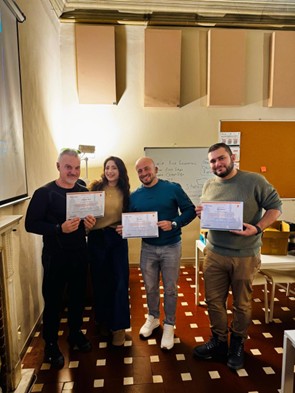
As part of Maria Regina Secondary School’s Development Plan 2025–2027, which promotes innovation in teaching and learning, three members of staff took part in an enriching Erasmus+ mobility experience focused on the course Transforming Education: Integrating AI, AR, VR, and 3D Printing for Effective Learning in Florence. This professional development opportunity was designed to strengthen educators’ understanding of emerging technologies and to explore how these can be used meaningfully to enhance student engagement, creativity and learning in today’s classrooms.
Throughout the course, participants were immersed in a dynamic international learning environment, collaborating with educators from different countries and sharing school contexts, ideas and practices. From the first day, the experience was highly interactive, with activities that encouraged teamwork, discussion and reflection. Participants explored digital tools such as Pear Deck, Trello and Padlet, while also being introduced to the SAMR model as a framework for integrating technology effectively in education. Sessions on Artificial Intelligence provided valuable opportunities to examine the growing role of AI in teaching and learning, including prompt engineering, AI chatbots, Google Gemini, Notebook LM, Curipod and other tools that can support lesson planning, revision and personalised learning.
As the course progressed, the focus expanded to immersive and creative technologies. Participants explored the educational potential of Augmented Reality and Virtual Reality through tools such as Google Cardboard, Meta Quest, ClassVR, Merge Cube and Assemblr AR, considering how these can support experiential and student-centred learning across subjects. Hands-on sessions in 3D modelling and printing further enriched the experience. Participants designing their own models in Tinkercad, preparing them for printing using Cura and Bambu Studio, and gaining practical insight into the technical processes involved, including calibration, filament changes and printer selection for schools.
This valuable Erasmus+ experience provided participants with practical strategies, fresh ideas and renewed motivation to continue embracing innovation in education. The knowledge and skills gained throughout the course will now contribute to classroom practice and wider school development, supporting a forward-looking approach to teaching and learning. By building capacity in digital and emerging technologies, the experience has further strengthened the school’s commitment to preparing learners for an increasingly technological and rapidly evolving world.